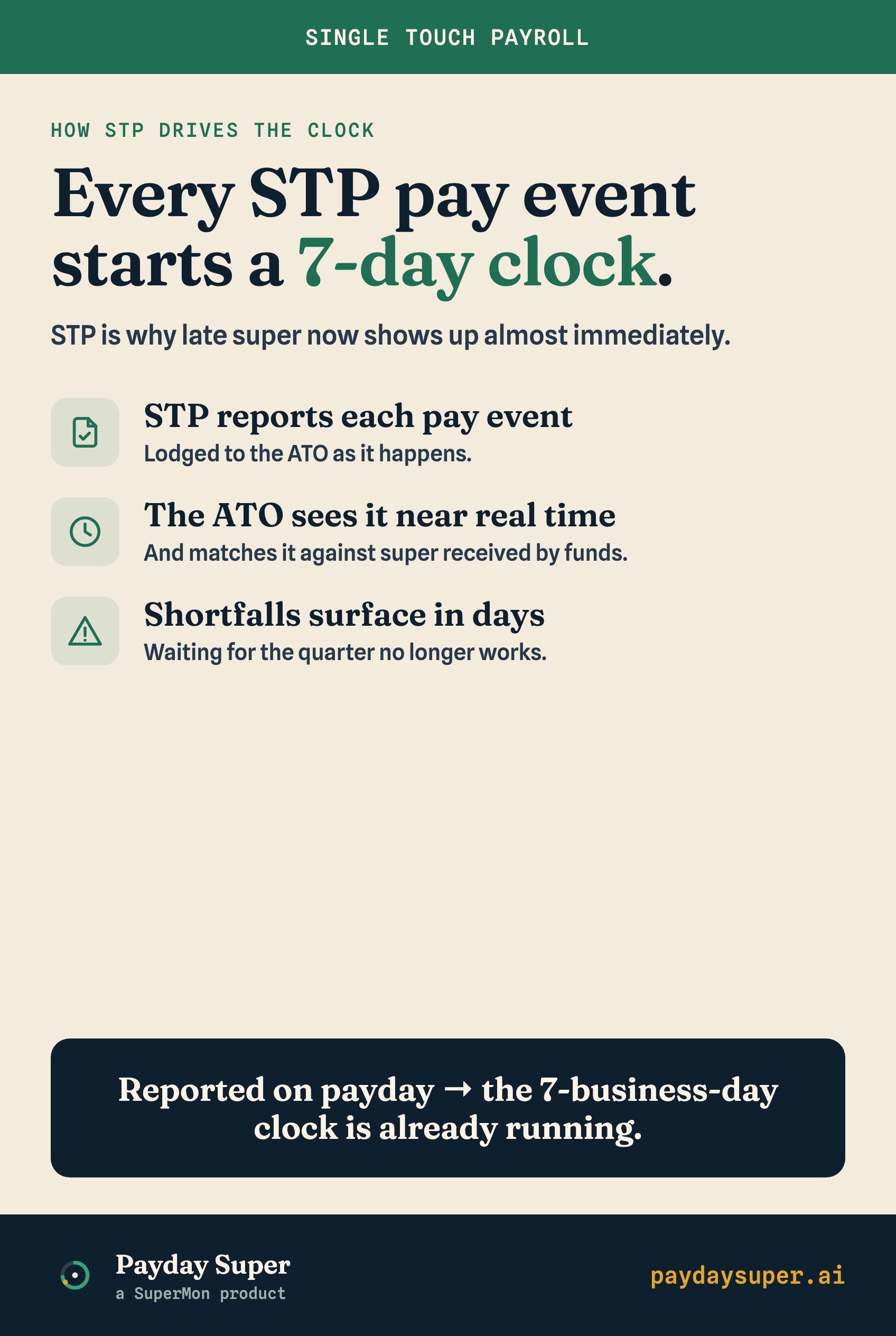
Single Touch Payroll already reports every pay event to the ATO at the moment you run payroll. Payday Super takes that signal and attaches a deadline to it. From 1 July 2026, each pay event you report through STP effectively starts a 7-business-day clock for super to reach the employee's fund.
That connection is the whole story. STP tells the ATO a payday happened. Payday Super says the super for that payday has to land within 7 business days. Put the two together and the ATO can see, almost in real time, which paydays have been reported and which ones haven't had matching super arrive in time.
This post walks through how the two systems link, what visibility the ATO gains, and why "she'll be right until the quarter" stops being a safe assumption.
What is the link between STP and the 7-business-day clock?
STP reports each pay event — who was paid, how much, and the payment date. That payment date is what starts the legal clock under Payday Super: super must be received by the employee's fund within 7 business days, counting from payday and excluding weekends and national public holidays.
So the pay event you lodge through STP and the event that triggers the super deadline are the same event. Reporting the pay run doesn't create the obligation by itself; the payment does. But because they happen together, every STP submission lines up with a deadline. That's why it's fair to say each STP-reported pay event effectively starts a 7-business-day countdown.
One thing worth keeping straight: the clock is measured on receipt by the fund, not on the day you submit the contribution or lodge STP. Submitting on day 6 isn't enough if the fund credits the member on day 8.
What can the ATO now see that it couldn't before?
The ATO gains two feeds and the ability to compare them.
- Pay events, in near real time. STP delivers each payday as it happens. The ATO knows the date wages were paid and the super that should follow.
- Contributions received, from the funds. Super funds report the contributions they receive for members.
Match one against the other and a gap becomes obvious: a pay event reported on a given payday, with no matching contribution received within 7 business days. Under the old quarterly system, that gap could sit unseen for months and only surface at a quarter-end reconciliation. Now the data to spot it arrives within days of each payday.
This is a structural change, not a tooling one. The ATO isn't waiting for an annual review to notice a pattern of late super. The reported pay events and the received contributions tell the story continuously.
How does this change shortfall detection?
It moves detection from after-the-fact to near-immediate.
Under quarterly SG, a shortfall was something you reconciled later — often when preparing the quarter's super, sometimes only when an employee queried their balance. There was slack in the system. You could be a few weeks behind and catch up before anyone noticed.
Under Payday Super with STP feeding the ATO, that slack is gone. Each payday is its own checkpoint. Miss the 7-business-day window on one pay run and there's a discrete, dated, visible event showing super didn't arrive on time. Multiply that across weekly payrolls and the exposure compounds fast: a single slow client on a weekly cycle can generate a late event every week, each one its own potential charge.
The financial consequence is the Super Guarantee Charge. When super is late, the SGC applies: the shortfall, nominal interest, and an administration component. It's calculated on total salary and wages rather than just OTE, so it can exceed the super that was actually owed, and it's not tax-deductible. ATO guideline PCG 2026/1 signals a more supportive stance in the first year for employers who are genuinely trying and correct mistakes quickly — but that's leniency in how the ATO engages, not an exemption from the charge. Check current ATO guidance for the precise mechanics.
Why doesn't "wait until the quarter" work anymore?
Because the quarter no longer exists for this purpose. The old quarterly deadline — 28 days after quarter end — applied to earnings paid up to and including 30 June 2026. For wages paid from 1 July 2026, there is no quarterly bucket to catch up in. Each payday stands alone with its own 7-business-day deadline.
The mental model has to change with it. Super used to be a periodic task you batched. Now it's a continuous obligation that fires on every pay event, and every one of those events is reported to the ATO as it happens. The reconciliation mindset — line it all up at quarter end and fix discrepancies then — is built around a buffer that the reform removed. There's nothing to reconcile into later, and the ATO can already see the gap.
For practices, that's the real shift. The work isn't harder per pay run; it's just relentless and visible. Every client, every cycle, every payday carries a deadline, and STP makes each one legible to the regulator.
What does this mean for how you monitor super?
It means monitoring has to run at the same cadence as payroll. If pay events fire continuously and each one starts a clock the ATO can see, then checking super monthly or at quarter end leaves you reacting to problems the regulator has already spotted.
Practically, that points to watching every client's pay events as they happen and tracking each 7-business-day deadline as it starts. SuperMon is built for exactly this rhythm: it connects to Xero read-only, reads each client's pay runs, tracks every 7-business-day deadline across your client base, and alerts you before anyone is late — MYOB support coming. STP made each payday visible to the ATO; continuous monitoring is how you stay one step ahead of that visibility, catching a deadline at risk days before it becomes a charge.