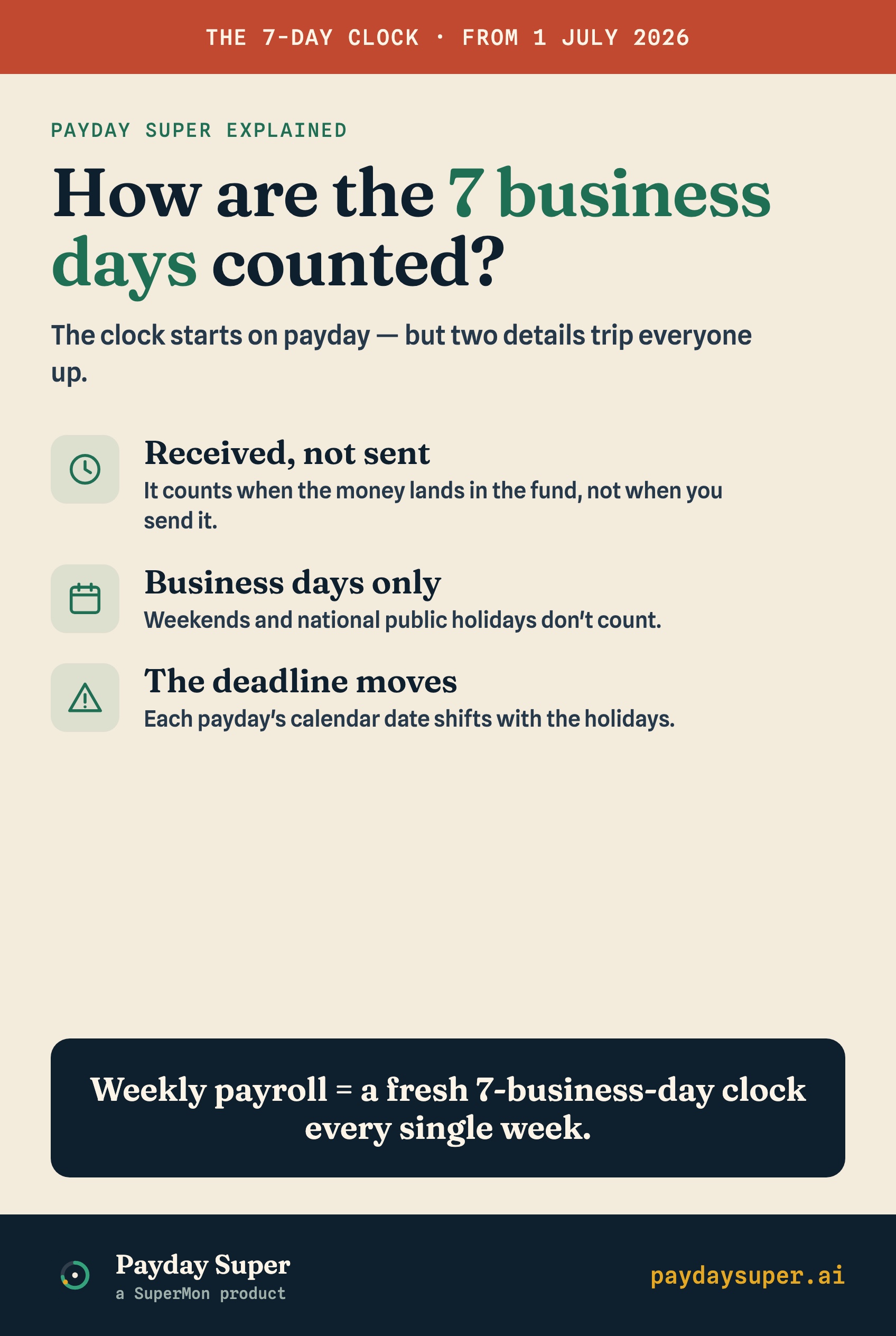
The 7-business-day rule sounds simple until you try to mark the deadline on a calendar. This is where most employers and their advisers trip up: business days are not calendar days, the clock counts to when the fund receives the money rather than when you send it, and a public holiday can quietly shift the date.
Get the count wrong and a payment you thought was early lands late. Here is how the counting actually works.
What does "7 business days" mean under Payday Super?
From 1 July 2026, Super Guarantee contributions must reach each employee's fund within 7 business days of payday. The rate is unchanged at 12% of ordinary time earnings. What changed is the timing, and the timing is measured in business days, not calendar days.
A business day excludes weekends and national public holidays. So 7 business days is never 7 calendar days. In an ordinary week with no holidays, 7 business days spans at least 9 calendar days because two weekends usually fall inside the window. Add a public holiday and it stretches further.
The payday itself is day zero. The count runs from the following business day. Treat the precise start convention as something to confirm against current ATO guidance, because being one day out is exactly the error this rule punishes.
Do weekends and public holidays count?
No. They are excluded from the count, which is the whole reason calendar maths fails here.
- Weekends never count as business days.
- National public holidays are excluded. A national holiday landing inside your window pushes the deadline out by one day for each one.
- State and territory holidays are handled differently from national ones. If your workers or your fund sit across multiple states, the answer can vary. Check current ATO guidance for which holidays apply to your circumstances.
The practical effect: the same payday in two different weeks can produce two different deadline dates, purely because of where the holidays land.
Sent or received: which one stops the clock?
The clock stops when the contribution is received by the employee's fund, not when it leaves your bank account or your clearing house.
This catches people out. You might pay on a Monday and assume you are done. But the money travels through your clearing house and the SuperStream network before it lands in the fund, and that journey takes time. If processing eats three or four days, your real safety margin is much smaller than 7 days.
Two takeaways follow from this:
- Pay early. Your deadline is the fund's receipt date, so build in buffer for clearing-house and SuperStream processing.
- Confirmation of receipt is what protects you, not your payment date. Keep evidence of when the fund actually received the contribution.
A worked example across a public holiday
Say you run a fortnightly payroll and pay employees on Friday 3 July 2026. Assume a national public holiday falls on the following Monday 13 July for this example. Counting business days from the next business day after payday:
| Day count | Date | Notes |
|---|---|---|
| Payday (day 0) | Fri 3 Jul | Clock starts; counting begins next business day |
| — | Sat 4 / Sun 5 Jul | Weekend, not counted |
| 1 | Mon 6 Jul | |
| 2 | Tue 7 Jul | |
| 3 | Wed 8 Jul | |
| 4 | Thu 9 Jul | |
| 5 | Fri 10 Jul | |
| — | Sat 11 / Sun 12 Jul | Weekend, not counted |
| — | Mon 13 Jul | National public holiday, not counted |
| 6 | Tue 14 Jul | |
| 7 | Wed 15 Jul | Deadline: fund must have received the contribution |
So a Friday payday produces a deadline almost two weeks later on the calendar, and the single public holiday added another day. Remember this is the receipt deadline. To hit Wednesday 15 July, you likely need to pay several days earlier so SuperStream processing completes in time. Dates in this example are illustrative; verify the public holiday calendar and counting rules against current ATO guidance.
Why weekly, fortnightly and monthly cycles create different clocks
Each payday starts its own 7-business-day clock. That means your pay frequency decides how many deadlines you are tracking.
- Weekly: roughly 52 separate deadlines a year. A new clock starts before the previous one closes, so deadlines overlap constantly.
- Fortnightly: around 26 deadlines a year, each spanning a longer calendar window because more weekends fall inside it.
- Monthly: about 12 deadlines, but each one carries a larger contribution, so a single missed deadline is costly.
There is no quarterly checkpoint anymore. Single Touch Payroll reports each pay event to the ATO, and under Payday Super each reported pay event effectively starts a 7-business-day clock. Off-cycle runs — bonuses, terminations, back pay — each start their own clock too.
What happens if you miscount and pay late?
If the contribution is not received in time, the Super Guarantee Charge (SGC) applies. It includes the shortfall, nominal interest and an administration component, it is not tax-deductible, and it is calculated on total salary and wages rather than just ordinary time earnings — so the charge can exceed the super you actually owed.
For the first year, ATO guideline PCG 2026/1 sets a more supportive compliance approach for employers genuinely trying to comply and correcting mistakes quickly. That changes how the ATO engages with you; it is not an exemption from the rule. Confirm the specifics against current ATO guidance.
Counting by hand across weekends, holidays and overlapping pay cycles is exactly the kind of work that goes wrong under pressure. Continuous monitoring is a better fit for a rule that runs continuously. SuperMon connects to Xero today on a read-only basis — it reads your pay runs but cannot move money or change payroll — tracks every client's 7-business-day deadline, and alerts you before anyone is late, so the count is watched for you rather than recalculated each pay run. MYOB support is coming soon.